Showing posts with label adjectival noun phrases. Show all posts

Saturday, 20 February 2016

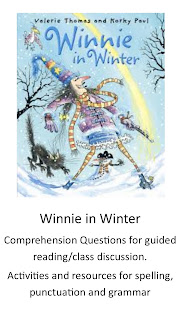
Winnie in Winter by Valerie Thomas and illustrated by Korky Paul

Winnie the witch and her cat Wilbur are fed up with feeling frozen and sick of the sight of snow. Winnie casts a spell and turns everything into summer. That is a big mistake. Her neighbours invade her garden and Winnie realises summer’s shortcomings. So she decides to cancel her spell and bring back the winter.

Winnie is a loveable witch who lives with her cat Wilbur. Children will enjoy reading about her antics and as there are so many titles about her, these make a great resource for an author study.

In this particular story, the contrasts are made between winter and summer in terms of clothing, weather, flora and fauna. References are made to animals who are hibernating and flowers that only grow in Spring/Summer. This makes it a good story to read aloud to any class who are studying the Seasons. There is also an interesting PHSE lesson in the story about respecting other people's property.

In terms of English, the story is simply told, making it ideal for those children who have successfully achieved phase 5 phonics. The text can also be used as a stimulus for a number of the spelling, punctuation and grammar objectives identified for year 2; in particular, apostrophes for omission, adjectives, noun phrases, the use of commas for separating words in a list, commands and sentence structure.

Korky Paul's illustrations give a certain charm to the story. Wilbur's facial expressions are wonderful and the detail in each of the full page spreads means there is always plenty to talk about. 

In Year 2, children will be able to explore the similarities between this story and other Winnie stories and will enjoy composing their own Winnie story, which they could illustrate in the style of Korky Paul.

A lovely, picture to share with children aged 3-7 as a read aloud book and as a literacy resource in year 2. Every Key Stage 1 library should have these on their shelves.


Publisher: Oxford University Press
Publication Date: 1996
ISBN: 978-0-19-273689-5


Thursday, 10 December 2015

Betty and the Yeti by Ella Burfoot


Ella Burfoot's story of a little girl called Betty who collects various items of clothing as she ventures across the frozen, snowy landscape, is a charming tale of friendship. Betty is an inquisitive character who befriends a Yeti and helps him to stay warm and make new friends.

The story would make a good stimulus for a science topic 'Keeping Warm'. As Betty ventures through the snow with her sled full of clothes, she meets various animals and inquires if the clothes she has found belong to them. Each of the animals tells Betty that they don't and explains why. Betty then meets the Yeti, who does need clothes to keep him warm.

It is also a story about friendship. The other animals are frightened of the Yeti, despite him being small, because of his appearance. However, this changes when they see Betty walking along holding the Yeti's paw.

The story is told in rhyme and as such provides numerous examples of alternative spellings for long vowel phonemes. Children could collect the examples, sort and classify them in preparation for a spelling investigation.

The language used is also rich with noun phrases. As Betty collects the various items of clothing they aren't simply listed. They are described using noun phrases which enable the reader the visualize each item: 'a little red sled', 'a jingly jangly fluffy hat', 'a woolly scarf', 'one enormous smelly coat'. It would be interesting to read the story to the children without them being able to 'see' the illustrations and get them to draw what they imagine the items (and the Yeti) to look like before introducing them to Ella Burfoot's own illustrations. This could then lead onto children composing their own noun phrases for items they might include in a story of their own.

The text is also a good model for investigating direct speech as in the short text there is a great deal of conversation between the various characters. This could be done through re-presenting the text as a comic strip or a play script.

Overall, a lovely humorous, little story which is a rich resource for the English curriculum and provides a stimulus for topic work in other curriculum subjects.


Published: 2010
Publisher: Macmillan
ISBN: 978-1-4472-8154-2


Wednesday, 19 August 2015

How to Wash a Woolly Mammoth by Michelle Robinson and illustrated byKate Hindley

Michelle Robinson's picture book How to Wash a Woolly Mammoth is a delightfully quirky instructional text. The teacher is a freckle faced little girl. She meticulously takes us through the ten essential steps of the process. Robinson's minimal text is supported by Hindley's clever illustrations.

For teachers at Key Stage 1, this will provide a welcome alternative to the usual instructional texts that are available. It contains all the features of the genre: a goal in the form of the title; step by step instructions that are chronological in order; diagrams to support the instructions. It is also written using the imperative form of the verb 'fill', 'add', 'start', 'wash' etc. Each step also contains adjectival noun phrases, thereby providing a good model for children's own writing. The little freckled girl charmingly warns us about some of the possible difficulties we might encounter when attempting to wash our mammoth 'a mammoth's tummy is terribly tickly'.

Many of the steps are accompanied by illustrations and diagrams to exemplify the instruction. For example step 1 'fill the bath' is supported by 2 diagrams on what appear to be post-it notes Fig. 1: Empty and Fig. 2: Full. Others are humorous drawings depicting how the reader might get their mammoth into the bath.

When the little girl shampoos the mammoth's hair, she can't help but experiment with a range of hair dos for her mammoth and these are delightfully illustrated in the form of eight square frames. Hindley portrays how the mammoth reacts to this pampering session through the use of facial expression: from closed contented eyes, to wide startled eyes. We learn of the mammoth's emotions by paying careful attention to the illustrations throughout the whole of the picture book.

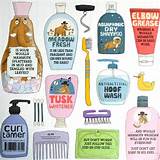
The end papers determine the actual beginning of the story and the end. At the beginning the little girl is playing with a bright blue star patterned ball and at the end after successfully washing her mammoth her wellies and ball are carefully placed together. The back cover depicts a whole range of mammoth related toiletries from bubble bath to tusk whitener and these have been cleverly used to display the ISBN of the book, the price and the synopsis.

How to Wash a Woolly Mammoth would be a useful and entertaining resource for any teacher who is studying instructional texts with his/her class as well as those who are investigating the Stone Age in history.

Publisher: Simon and Schuster
Publication date: 2013
ISBN: 978-0-85707-580-2