Showing posts with label year 2. Show all posts

Saturday, 20 February 2016

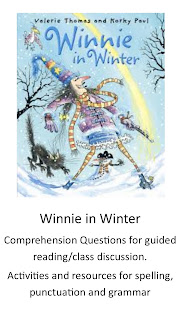
Winnie in Winter by Valerie Thomas and illustrated by Korky Paul

Winnie the witch and her cat Wilbur are fed up with feeling frozen and sick of the sight of snow. Winnie casts a spell and turns everything into summer. That is a big mistake. Her neighbours invade her garden and Winnie realises summer’s shortcomings. So she decides to cancel her spell and bring back the winter.

Winnie is a loveable witch who lives with her cat Wilbur. Children will enjoy reading about her antics and as there are so many titles about her, these make a great resource for an author study.

In this particular story, the contrasts are made between winter and summer in terms of clothing, weather, flora and fauna. References are made to animals who are hibernating and flowers that only grow in Spring/Summer. This makes it a good story to read aloud to any class who are studying the Seasons. There is also an interesting PHSE lesson in the story about respecting other people's property.

In terms of English, the story is simply told, making it ideal for those children who have successfully achieved phase 5 phonics. The text can also be used as a stimulus for a number of the spelling, punctuation and grammar objectives identified for year 2; in particular, apostrophes for omission, adjectives, noun phrases, the use of commas for separating words in a list, commands and sentence structure.

Korky Paul's illustrations give a certain charm to the story. Wilbur's facial expressions are wonderful and the detail in each of the full page spreads means there is always plenty to talk about. 

In Year 2, children will be able to explore the similarities between this story and other Winnie stories and will enjoy composing their own Winnie story, which they could illustrate in the style of Korky Paul.

A lovely, picture to share with children aged 3-7 as a read aloud book and as a literacy resource in year 2. Every Key Stage 1 library should have these on their shelves.


Publisher: Oxford University Press
Publication Date: 1996
ISBN: 978-0-19-273689-5


Friday, 22 January 2016

Charlie Crow in the Snow by Paula Metcalf and illustrated by CallyJohnson-Isaacs


Stories about the Seasons
Metcalf's story Charlie Crow in the Snow is a lovely picture book story about friendship and the changing seasons.

Charlie Crow loves him home in the tree and enjoys visits from his friends Bear and Swallow. However, things begin to change, much to Charlie's surprise. Charlie Crow hasn't seen snow before and when he does see it for the first time he panics and goes to find his friends. He can't find bear and Swallow. However, he does bump into Squirrel who is just as confused and between them they set off to find Bear and Swallow who will surely know the answer to what is going on.


The story beautifully introduces children to the changing seasons from Autumn through to winter. Children will learn about how leaves fall from trees, water turns to ice, snow, hibernation and migration.

It would make a lovely read-aloud story for Foundation Stage and Key Stage 1. It would also make a lovely guided read for children who have mastered phase 5 phonics. In terms of comprehension there are ample opportunities to teach wither through shared or guided reading each of the 5 domains that are identified in the Key Stage 1 Reading Tests, in particular 1a vocabulary, 1b identify key aspects of fiction and 1d make inferences from the text.

The dialogue within the story uses a wide variety of synonyms for said such as squawked, whimpered, cried, shrieked and exclaimed allowing teachers the opportunity to develop children's vocabulary, consider characterisation and further children's grammatical knowledge in context.

The illustrations are bright and clearly depict the different colours and tones associated with the different seasons. Also, the expressions on the characters faces are an absolute delight. The positioning of the eyebrows on each of the characters emphasise the emotions felt by each of the characters at any one particular time and would therefore support the teaching of comprehension  and emotional intelligence. My favourite, I think is the page where Charlie Crow and Squirrel attempt to hibernate with Bear.

Characterisation and emotions


Publisher: Macmillan 
Publication Date: 2013
ISBN: 978-1-4472-8155-9


Tuesday, 8 September 2015

Tappity-Tap! What Was That? By Claire Freedman and illustrated byRussell Julian

Claire Freedman's picture book story, Tappity-Tap! What Was That? Is a charming story about friendship and facing your fears. On a dark and stormy night, Owl, Mouse and a Rabbit hear a knock at the door and fear the worst - The Monster of the Woods. As the story progresses we witness them as they support each other in facing their fears: from Owl's plan just in case they should encounter the Monster, to curling up together in front of the fire with a cup of hot cocoa to finally finding the courage to peep through the peephole to see who it is at the door.

This is a beautiful book to share with young children. It would generate a great deal of discussion around the subject of fear: the kinds of things that children fear, who they turn to when they are afraid and the sorts of things that make them feel better. Owl, who is the largest of the animals in the story, takes on the traditional role of being the 'wise old owl' and as such the parental figure that the smaller animals turn to. This makes the text ideal to discuss charaterisation. What are Owl's qualities that make others turn to him for comfort? What evidence is there in the story to support the children's views?

For children in year 2, who need to develop their vocabulary and use a variety of synonyms for 'said', the text proves to be a good model of how to do this. Teachers need to consider with the children why Freedman has chosen to use the variety of words for 'said' that she does. What additional information do these choices give the reader. For children in year 3, it would be interesting to 'collect' the different words and then categorise them. Which synonyms for 'said' does Freedman use to indicate fear? 'gulped', 'trembled', 'shivered' etc. How might you categorise the other synonyms?

In terms of scene setting, Freedman creates the atmosphere of the storm through the use of onomatopoeia: crash, bang, howl, thump. The atmosphere of the story is further enhanced by Russell Julian's illustrations. The darkness that envelops owl, literally and metaphorically as he pretends not to be at home when he hears the tappity-tap tap, how the peephole in Owl's door enlarges the eye when rabbit looks in and reduces the size of the Monster when the three of them look out, the eeriness of the shadows as we peer through Owl's window. The black silhouetted image which contains the words 'The Monster of the Woods' depicts how through fear we tend to make things much bigger than they are in reality. Note the size of the spider and the unidentifiable fronds in comparison with the three friends. The images of the woods in the end papers could provide a stimulus for some descriptive writing. How could the children describe the trees to create that same sense of eeriness?

A picture book which could be read and enjoyed by children of all ages and in terms of the classroom can be used in a variety of ways to develop children's reading and writing.

Publisher: Scholastic
Publication Date: 2009
ISBN: 978-1-407131-68-9


Wednesday, 29 April 2015

Jake's Cave by Lou Kuenzler, illustrated by Nick Maland

"Your imagination made that cave big enough for a dragon," said Uncle Paul. "A dragon as big as a bus!"


Jake is excited when Uncle Paul offers to take him and his little sister out for the day. Jake wants to go to the big dark cave at the beach – they haven't been there for ages, and he can pretend to be a brave knight and save Princess Pip from the terrifying dragon. Pip is excited too: she'll get to wear her princess costume, and she knows that Sir Jake the Brave will save her! But when they arrive, the cave is much smaller than Jake remembers; he's too big even to fit inside it. Jake is so disappointed. Why can't things just stay the same? He soon realizes, however, that it's your imagination that counts. He'll just have to pretend – for Princess Pip!


Jake's Cave is a well written story, perfect for children who have gained independence in reading and need to build their confidence and stamina. It is one of the 'Walker Story' collection, which is advertised as 'the perfect first step into fiction.' The story is told in 3 short chapters, not three short stories, as stated on the back cover of the book. It is one complete story. The first chapter provides the orientation of the story. The second chapter is the build up leading to the problem and the final chapter explores the problem, provides the climax and finally the resolution.

The language used in the book provides a good quality model for children's own writing. Each of the three characters are developed through the use of dialogue which utilises a range of alternatives for 'said'. Teachers in years 2 and 3 could use extracts from the book for discussion and examples of how to punctuate direct speech and vocabulary development.

There are also some lovely examples of descriptive language, such as 'a shimmer of sea, sparkling bright blue in the sun.' Other examples make use of simile: 'as big as a bus and bright red. As shiny as your new Wellies.' Immersing children in quality fiction which models such language features will have a positive impact on the quality of the children's own writing.

Being a short story, organised into 3 chapters, also makes it ideal for use during guided reading in years 2 and 3. Each chapter could be managed in one guided reading session. Comprehension skills of inference and deduction can be developed through discussion of key aspects of characterisation. For example, in chapter 1, why does Jake think that Pip is likely to have a tantrum? Children will have to draw on their prior knowledge of younger siblings and evidence drawn from other known texts to be able to answer that. Likewise, in chapter 2, why does the walk to the cave seem much shorter than Jake remembered?

The black and white illustrations provide support for those children who are making the transition from picture books to longer chapter books. They also help visualise the different settings encountered during the story: Jake and Pip's home, the town in which they live, the journey through the countryside and finally the beach. These would provide a useful resource for comparing and contrasting the different settings. 

All in all, Jake's Cave is a story that will be enjoyed by both girls and boys aged 6-8. By the end of year 2, many children will probably be able to read the book independently. 


Published: 2010 by Walker Books
ISBN: 978-1-4063-2153-1
   

Wednesday, 11 February 2015

Penny Dreadful is a Magnet for Disaster by Joanna Nadin

Penny Dreadful is a Magnet for Disaster contains three adventures starring Penny Jones, a girl who comes up with plenty of ‘brilliant’ ideas. Each story is a complete story in itself. Penny Dreadful isn't her real name, it's a nickname given to her by her father. Her gran says she is a ‘Magnet for Disaster’ and certainly in these three stories she lives up to both descriptions. This is because Penny's 'brilliant' ideas frequently don’t turn out in the way that she planned and usually have disastrous consequences. With the help of her best friend Cosmo, Penny manages to superglue her cousin Georgia May Morton-Jones to the carpet, steal a dog and amaze the school inspector.
These are fun stories that read aloud well and are supported by lively illustrations by Jess Mikhail. Children in years 2 and 3 will enjoy reading about Penny's disasters. The themes of the stories are similar to those in Francesca Simon's Horrid Henry and David Roberts' Dirty Bertie, but this time the protagonist is female. However, due to the style of writing, children will need to have developed a little more reading confidence to read these books independently than either the Horrid Henry or Dirty Bertie series.
It is very difficult not to love Penny Dreadful as she hurtles from one disaster to the next. The books are narrated in the first person and Penny chats away unstoppably and is so utterly believable. The stories are fast-paced and the style in which they are written enhances the character of Penny. Each of the characters are quirky and loveable in their own way. The storytelling is only broken up by the equally quirky and perfectly matched illustrations provided by Jess Mikhail. There are lots of amusing pictures with highlighted and capitalised text bubbles to enhance the fast pace and humour.
Penny Dreadful is a Magnet for Disaster would be an ideal book for use during guided reading for those children who have developed their reading confidence and are ready to discuss how an author's style adds to the meaning of a text. (The old AF 5). There is much to discuss such as the ways in which the text has been broken up with speech bubbles, lists and different sizes of text affect the children's reading and enjoyment of the story. Why Penny's 'brilliant' ideas never seem to work out the way she planned and how do the author and illustrator make the stories so funny? The stories also lend themselves to work on characterisation. Each character has their own distinctive character traits which will make it easy for children in year 3 to identify and therefore, develop their understanding of character traits. Jess Mikhail's illustrations of each of the characters at the front of the book could easily be enlarged for a working wall display identifying the adjectives which describe each of the characters.
In Year 4 the stories would also be a good resource for looking at events from different points of view. Using Anthony Browne's book Voices in the Park as a model children could retell the events from a range of different points of view. So, for example 'Penny Dreadful and the Faithful Sidekick' could be explored from the points of view of Aunt Deedee and Mrs Higgins. What are their stories? Other ideas include writing their own Penny Dreadful story or re-writing one of the stories as a play.
Penny Dreadful is a Magnet for Disaster was shortlisted for the Roald Dahl Funny Prize.


  • Publisher: Usborne
  • Date of Publication: 2011
  • ISBN: 978-1-4095-2672-8


Tuesday, 13 January 2015

Oliver Moon and the Potion Commotion by Sue Mongredien

Oliver Moon is the hardest working wizard at Magic School and now he's been nominated for Young Wizard of the Year. But at home, he has to cope with his seriously embarrassing unmagical parents. What will the judges say when they find out that the Moons use a microwave instead of a cauldron and a car instead of a broomstick?

Schools and magic are a winning combination, and Oliver Moon's adventures bring the genre to younger readers who are just gaining their reading independence and developing reading stamina. It is in the form of a chapter book and is ideal for year 2/3 class libraries and would also make an ideal text for guided reading. 

Oliver Moon is the younger reader's 'Harry Potter'. Children will revel in the descriptions of the disgusting living conditions and diet required of all the best wizards, and in the distinctive illustrations! Oliver Moon and the Potion Commotion is the first in a series of books. The story itself has the perfect combination of tension and humour which will keep children wanting to read. The chapters are short enough for those who have just attained reading independence and as such the series would be 'the next step' from books which are anthologies of short stories such as 'Horrid Henry' and 'Dertie Bertie'

Sue Mongredien's writing style provides an excellent model for alliteration. She not only makes use of alliteration for the use of characters' names but also regularly in noun phrases such as 'scorpion stew', 'sausage sandwich' and 'pig-trotter pies'. She also makes use of a wide range of alternative vocabulary for 'said'. In the first chapter you will come across 'pointed out', 'echoed', 'slurped', 'reminded', 'squeaked', 'announced', 'yelped', 'cried' and 'begged'.

The book's underlying message is a valuable one – that we need to work together to achieve, and when we do, it brings satisfaction for all.

Publisher: Usborne
ISBN: 978-0-7460-7306-3