Tuesday, 23 February 2016

The Mozart Question by Michael Morpurgo and illustrated by Michael Foreman

The Mozart Question is a short illustrated novella, suitable for pupils in Years 5 and 6.

It is the story of a young journalist, set in Venice in approximately the year 2000. She has been sent to interview the world renowned violinist Paolo Levi with strict instructions not to ask 'the Mozart Question'. During her visit, we learn not only of Paolo's life but that of his parents who were prisoners in Auschwitz during the Second World War. Secrets which have been kept for almost 50 years are revealed as Paolo recalls being told that all secrets are lies, and now 'the time has come...not to lie anymore'.

The book would make an excellent class read for any year 5 or year 6 class who are studying World War II or as part of a class collection of books linked to the topic such as A Candle in the Dark, Goodnight Mr. Tom, When Hitler Stole Pink Rabbit and Carrie's War. Taken as a group these stories each provide a slightly different perspective on World War II. This allows children to vicariously experience the war through different eyes.

The story ends up being 3 stories in one, a little like a set of Russian dolls. We begin with Lesley's story: the young journalist who is given the assignment of interviewing Paolo. Next we hear Paolo's story as told to Lesley and finally the story of Paolo's parents as told to Paola. This makes the structure of the story an interesting one to examine as it involves two specific time slips as the different stories are told. We are never throughout the story told what the actual 'Mozart Question' is, although we can infer what it might have been by the end of the book.

Despite its short length, this book may still prove to be a challenging read for some pupils in year 5 and 6 due to the vocabulary that is used such as machinations, incongruous, obsequiousness, reticent and tutelage. This though, makes it ideal for developing pupils vocabulary, particularly during small group discussion such as guided reading.

The book is set in three different places: London ,briefly at the beginning, Venice and Auschwitz. The latter two settings contrast starkly and these are depicted beautifully in Michael Foreman's illustrations. Pupils could use these detailed images as stimuli for descriptive writing.


The book does not contain Lesley's newspaper article and this would make an interesting follow-up piece of writing for the children. Lesley has been given a great deal of detail in her interview with Paola and pupils will need to decide what to keep and what to discard. This would necessitate a careful examination of the difference between newspaper reports and biography/narrative.

At the end of the book Michael Morpurgo includes an Author's Note. This provides a brief factual summary about how some Jewish prisoners were selected to play music in the concentration camps and a short paragraph about his stimulus for the story.


Publisher: Walker Books 
Publication Date: 2015 (this edition)
ISBN: 978-1406366396


Saturday, 20 February 2016

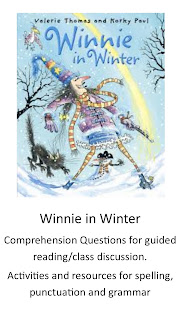
Winnie in Winter by Valerie Thomas and illustrated by Korky Paul

Winnie the witch and her cat Wilbur are fed up with feeling frozen and sick of the sight of snow. Winnie casts a spell and turns everything into summer. That is a big mistake. Her neighbours invade her garden and Winnie realises summer’s shortcomings. So she decides to cancel her spell and bring back the winter.

Winnie is a loveable witch who lives with her cat Wilbur. Children will enjoy reading about her antics and as there are so many titles about her, these make a great resource for an author study.

In this particular story, the contrasts are made between winter and summer in terms of clothing, weather, flora and fauna. References are made to animals who are hibernating and flowers that only grow in Spring/Summer. This makes it a good story to read aloud to any class who are studying the Seasons. There is also an interesting PHSE lesson in the story about respecting other people's property.

In terms of English, the story is simply told, making it ideal for those children who have successfully achieved phase 5 phonics. The text can also be used as a stimulus for a number of the spelling, punctuation and grammar objectives identified for year 2; in particular, apostrophes for omission, adjectives, noun phrases, the use of commas for separating words in a list, commands and sentence structure.

Korky Paul's illustrations give a certain charm to the story. Wilbur's facial expressions are wonderful and the detail in each of the full page spreads means there is always plenty to talk about. 

In Year 2, children will be able to explore the similarities between this story and other Winnie stories and will enjoy composing their own Winnie story, which they could illustrate in the style of Korky Paul.

A lovely, picture to share with children aged 3-7 as a read aloud book and as a literacy resource in year 2. Every Key Stage 1 library should have these on their shelves.


Publisher: Oxford University Press
Publication Date: 1996
ISBN: 978-0-19-273689-5


Wednesday, 10 February 2016

Operation Eiffel Tower by Elen Caldecott

Operation Eiffel Tower is a modern day, family drama. The story and characters are all believable and as a reader you very quickly get drawn in and involved in the family that is at the heart of this story and the events that unfold. 
In the first chapter we are introduced to the family, who live in a seaside town, where, Jack (the main character) helps out at the crazy golf course. The story opens as Jack hits his golf ball triumphantly into the final 18th hole, right between the feet of the Statue of Liberty, whilst his older sister Lauren sits nearby, engrossed in Teen Thing magazine. Caldecott's style in this opening chapter lulls you into thinking that this might be a likeable, lightly amusing tale of a family with little money to spare. However,  the final sentence though suggests otherwise 
“Her shift was officially over. She smiled and waved at Jack and Ruby. Now they could all go home. Jack felt his heart sink.”
We soon learn that the children's parents argue. Sometimes it's so bad that Ruby gets afraid and goes to sleep in Jack's bed. In fact it becomes so bad that Dad moves out. Then, the four children fear that Dad will never come home and so they launch Operation Eiffel Tower - a surefire plan to get their parents back together...
Jack's email correspondence with Paul and the concluding events in the story make some interesting points about conflict and reconciliation.
The story itself is beautifully told. Caldecott really does use her style of language to create mood and emotion. As a reader, through the writing you can at one minute be relaxed and enjoy the gentle and often touching scenes between brother and sister, next you are jolted into a sudden foreboding much in the same way as a film watcher anticipates events through the music. For example, in chapter 10 Caldecott creates a light, fun-loving atmosphere, in her description of Jack.
'Jack Froze. He was stiller than a moon rock. He was more frozen than a moon rock in a fridge-freezer. He was more silent than a sulking moon rock in a fridge-freezer.'

Next, when the children return home, the use of the short sentence - 'Then Jack stopped' - creates a sudden and abrupt change in mood. At this point, and throughout the whole book, Caldecott uses style of language to echo Jack's emotions. This makes the book ideal for using in years 5 and 6 not only for guided/independent reading but also as a model for children's own writing when looking at varying sentence length for effect.

This book is just so brilliantly observed. Each of the children react slightly differently to the crisis in their parents' marriage. Jack, the central character, is old enough to fully understand the implications for the family and he is in denial. He wants his parents to stay together at all costs and he'd do anything to make that happen. Ruby, on the other hand,  is much younger and still jealous at being supplanted by Billy as the baby of the family. So her idea to raise cash for the trip to Paris is simply to sell Billy to a prospective adopting couple. Again, the characterisation throughout the book lends itself to whole class and/or group discussions. As a read, the book is accessible and a relatively easy read but this is what makes it the ideal text to use when discussing more complex issues such as author's use of language, themes and characterisation.
It is easy to read and it is funny at times and desperately sad at others: a real roller coaster for the emotions. Eventually though, despite a change of plan, the book arrives at what is probably the best ending possible;a note of realistic hope for everyone.
The cover of the book includes a booksellers caption ' perfect for Jacqueline Wilson fans'. Whilst I do not disagree with this, there is a chance that children who are not Jacqueline Wilson fans (and many boys aren't because the protagonists of most of her stories are female) might be put off. This book will appeal to a wider range of readers, boys and girls alike, as the protagonist is male; the drama is fast paced and there are references to the army as well as themes that many contemporary children will be able to relate to.


Publisher: Bloomsbury
Publication date: 2011
ISBN: 978-1-4088-0573-2


Friday, 22 January 2016

Charlie Crow in the Snow by Paula Metcalf and illustrated by CallyJohnson-Isaacs


Stories about the Seasons
Metcalf's story Charlie Crow in the Snow is a lovely picture book story about friendship and the changing seasons.

Charlie Crow loves him home in the tree and enjoys visits from his friends Bear and Swallow. However, things begin to change, much to Charlie's surprise. Charlie Crow hasn't seen snow before and when he does see it for the first time he panics and goes to find his friends. He can't find bear and Swallow. However, he does bump into Squirrel who is just as confused and between them they set off to find Bear and Swallow who will surely know the answer to what is going on.


The story beautifully introduces children to the changing seasons from Autumn through to winter. Children will learn about how leaves fall from trees, water turns to ice, snow, hibernation and migration.

It would make a lovely read-aloud story for Foundation Stage and Key Stage 1. It would also make a lovely guided read for children who have mastered phase 5 phonics. In terms of comprehension there are ample opportunities to teach wither through shared or guided reading each of the 5 domains that are identified in the Key Stage 1 Reading Tests, in particular 1a vocabulary, 1b identify key aspects of fiction and 1d make inferences from the text.

The dialogue within the story uses a wide variety of synonyms for said such as squawked, whimpered, cried, shrieked and exclaimed allowing teachers the opportunity to develop children's vocabulary, consider characterisation and further children's grammatical knowledge in context.

The illustrations are bright and clearly depict the different colours and tones associated with the different seasons. Also, the expressions on the characters faces are an absolute delight. The positioning of the eyebrows on each of the characters emphasise the emotions felt by each of the characters at any one particular time and would therefore support the teaching of comprehension  and emotional intelligence. My favourite, I think is the page where Charlie Crow and Squirrel attempt to hibernate with Bear.

Characterisation and emotions


Publisher: Macmillan 
Publication Date: 2013
ISBN: 978-1-4472-8155-9


Saturday, 16 January 2016

The Legend of the Worst Boy in the World by Eoin Colfer, illustrated byTony Ross

Eoin Colfer's book The Legend of the Worst Boy in the World is told in the first person from the point of view of Will, a young boy of 9 who has 4 brothers. Unfortunately for Will, having 4 brothers and 3 of them younger than him means that he often doesn't get the attention he feels he needs and deserves from his Mum and Dad. However, he finds the perfect audience to listen to his tales of woe in the form of Grandad. Children in lower Key Stage 2 will love the ensuing competition between Will and Grandad to see who can tell the story with the biggest problem. They will be able to relate to many of Will's 'problems' and will be amused and engaged by Grandad's tales.

The story contains a second story which is cleverly woven into the main narrative. This story is in stark contrast to the main story which is told through gentle humour. Instead, the second story is full of suspense, tension and action as Will's older brother carries out a plan to get rid of 2-year-old Will. This shorter story within the story is ideal for exploring story structure, identifying the problem, build-up and resolution. Through guided reading children could discuss how Colfer builds up the tension. The sentences are short and simple, thereby quickly drawing the reader into the action. This also makes the text accessible for those who have just gained independence in reading. The text is accompanied by black and white illustrations by Tony Ross, which makes it a suitable 'transition' text from picture book to novel.

Colfer's storytelling is so good that at the end of the book he is able to explain to his readers the meaning of 'moral of the story' in such a way that feels natural and integral to the story itself. This would allow teachers to explore 'morals in stories' with their classes and identify other tales which have morals and what those morals are. The title 'the Legend of...' also provides opportunity to investigate and explore other types of tale/story. So, within this one book we have 3 story genres 1) the contemporary familiar setting story 2) the fable and 3) the legend. Pupils could investigate the features of all three and compare and contrast them and collect examples of each.

There is also ample opportunity for language study from the invention of new words to the use of adjectives to create vivid and funny descriptions, to simile to aid visual understanding.

The fact that the story is told in the first person means that the tale will appeal to a wide range of readers in lower key stage 2, including boys and possibly even those who have not yet caught the bug of reading for pleasure. A great book which deserves a place in the class library for independent reading but also one which has the potential for study both with the whole class and small groups.


Publisher: Puffin
Publication Date: 2008


Saturday, 2 January 2016

The Tale of Jack Frost by David Melling

The Tale of Jack Frost by David Melling is a beautiful picture book based on the mythical creature. Jack, somehow wanders into the shielded magical forest. The magical inhabitants instantly take to him and teach him magic. Jack is a natural showing a particular skill for creating ice and snow. However, Jack's presence is also cause for concern as he has left the way into the forest open. This means the magical creatures are in danger from the greedy Goblins.
The tale unfolds in a way which is not dissimilar to many other fairy tales. Jack tricks the Goblins into thinking that the reflection if the moon in the lake is in actual fact the sun. Children will enjoy the humour in the story and the detailed illustrations.
The illustrations in the book are vivid watercolours, which capture the setting of the enchanted forest. As such the text would provide an excellent stimulus for any Key Stage 1 or even lower Key Stage 2 class who are looking at descriptive writing and settings. 
The opening sentence 'It was a crisp and frosty morning.' is accompanied by a beautiful, detailed, full page illustration in cool blues of the boy asleep and two snow-beetles. 

The following two-page spread zooms out from the scene to introduce us to the other creatures of the forest. These are also introduced through the written text 'Shadows came bobbing and gliding towards them from every direction.'

The characters in the story are also vividly described: 'Cowslip, a tall and gentle creature with hairy knees, spoke first.' The descriptions focus not just on the characters' physical appearance but also their traits and children will enjoy reading about the grotesque traits of the Goblins. 
As a story as a whole, the structure is simple for children to identify the beginning, the build-up, problem, climax and resolution. It also includes the features associated with fairy stories: good versus evil, magic, mythical creatures etc. It has also been animated by the BBC and is available on DVD.
Overall, the Tale of Jack Frost by David Meling is a good read-aloud story for foundation stage, Key Stage 1 and lower Key Stage 2 which also provides a great deal of opportunities for studying descriptive language particularly of setting and character.

Publisher: Hodder Children's Books
Publication Date: PB edition 2004
ISBN: 0-340-85200-3
     

Thursday, 10 December 2015

Betty and the Yeti by Ella Burfoot


Ella Burfoot's story of a little girl called Betty who collects various items of clothing as she ventures across the frozen, snowy landscape, is a charming tale of friendship. Betty is an inquisitive character who befriends a Yeti and helps him to stay warm and make new friends.

The story would make a good stimulus for a science topic 'Keeping Warm'. As Betty ventures through the snow with her sled full of clothes, she meets various animals and inquires if the clothes she has found belong to them. Each of the animals tells Betty that they don't and explains why. Betty then meets the Yeti, who does need clothes to keep him warm.

It is also a story about friendship. The other animals are frightened of the Yeti, despite him being small, because of his appearance. However, this changes when they see Betty walking along holding the Yeti's paw.

The story is told in rhyme and as such provides numerous examples of alternative spellings for long vowel phonemes. Children could collect the examples, sort and classify them in preparation for a spelling investigation.

The language used is also rich with noun phrases. As Betty collects the various items of clothing they aren't simply listed. They are described using noun phrases which enable the reader the visualize each item: 'a little red sled', 'a jingly jangly fluffy hat', 'a woolly scarf', 'one enormous smelly coat'. It would be interesting to read the story to the children without them being able to 'see' the illustrations and get them to draw what they imagine the items (and the Yeti) to look like before introducing them to Ella Burfoot's own illustrations. This could then lead onto children composing their own noun phrases for items they might include in a story of their own.

The text is also a good model for investigating direct speech as in the short text there is a great deal of conversation between the various characters. This could be done through re-presenting the text as a comic strip or a play script.

Overall, a lovely humorous, little story which is a rich resource for the English curriculum and provides a stimulus for topic work in other curriculum subjects.


Published: 2010
Publisher: Macmillan
ISBN: 978-1-4472-8154-2